
English| EUR
Suggested for you
More currencies
Choose a language
Between December and early April, the frozen canyon draws more vehicles than the roadside lots off the Bow Valley Parkway were ever built to hold. This johnston canyon ice walk parking guide explains how the lots behave through a winter day, what a Parks Canada pass covers, and why the arrival window matters more than the lot map.
Quick answer
Parking at Johnston Canyon is free, but every vehicle needs a valid Parks Canada pass for Banff National Park, priced at 12.25 CAD for a daily adult pass. The trailhead lots off Bow Valley Pkwy, Improvement District No. 9, are open around the clock, yet capacity is the real limit: spaces are typically claimed well before midday on clear winter weekends.
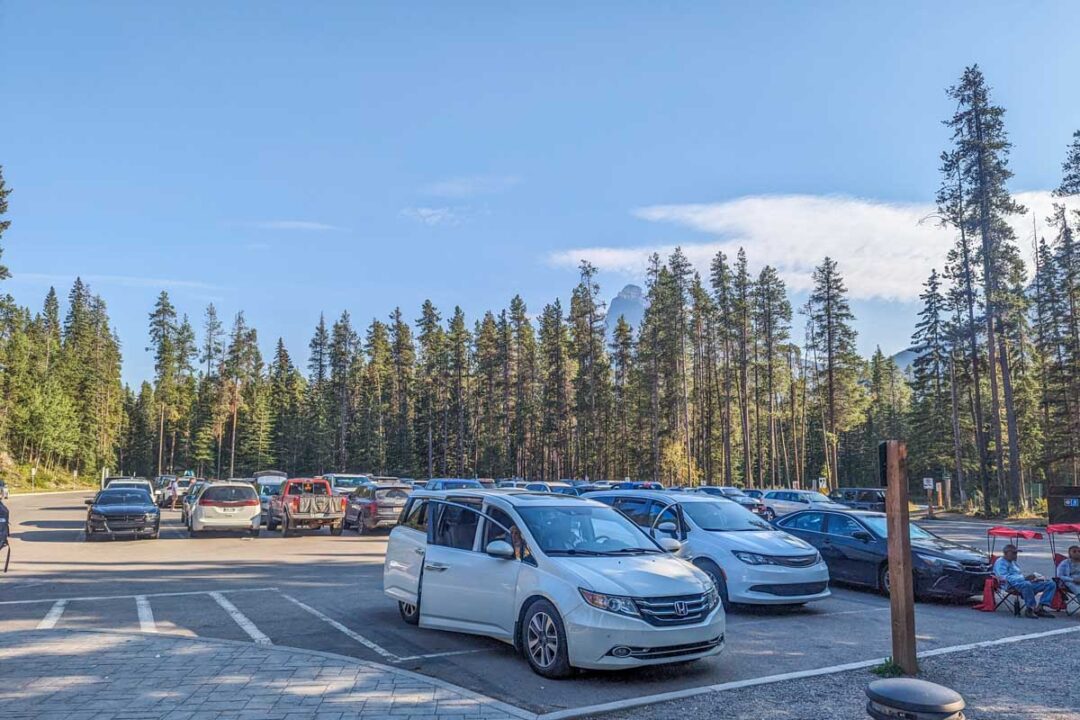
Johnston Canyon's parking problem is a seasonal inversion. The lots were sized for a summer waterfall walk, then winter turned the same gorge into one of the busiest ice destinations in the Canadian Rockies — and the Bow Valley Parkway that serves it narrows, ices over, and offers almost no legal shoulder for overflow. Demand rose; supply did not. That single mismatch explains nearly every frustration visitors report about johnston canyon ice walk parking. What a driver actually faces is a compact set of paved bays beside the highway, plus a smaller secondary area near the lodge, both bounded by snowbanks that shrink usable stalls as the season deepens. A plowed lot in January holds noticeably fewer vehicles than the same lot in October, because banked snow eats the outer rows and buries the painted lines. Parks Canada does not permit parking on the roadway itself, and vehicles left on the Bow Valley Parkway shoulder risk ticketing or towing — the road is a designated wildlife corridor with seasonal travel restrictions, not an overflow strip. Guided icewalk operators pick up at fixed points for this reason, and many Banff National Park visitors let a tour handle the vehicle question entirely rather than gamble on a stall. The pass system is separate from the stall itself. Nothing is charged for the space; what is checked is the park entry permit displayed on the windshield, valid for the whole of Banff National Park rather than for the Johnston Canyon trailhead specifically. Travellers arriving from Lake Louise or Castle Junction usually already hold one. The practical takeaway is that Johnston Canyon winter parking is a timing question disguised as a location question. There is no hidden second lot, no reservation queue, and no shuttle dedicated to the canyon in winter. Drivers who reach the trailhead early find the lower falls catwalks quiet and the return walk uncrowded; those who arrive mid-afternoon on a bluebird Saturday often circle, wait for a departure, or drive on toward Castle Mountain. Reading this johnston canyon ice walk parking guide alongside the arrival-window and directions sections on this site will give the full picture — one covers when to come, the other covers how to get there safely on a winter road. Both matter more than any map of the stalls.
“The lots were sized for a summer waterfall walk, then winter turned the same gorge into one of the busiest ice destinations in the Canadian Rockies.”
To secure parking and avoid heavy trail crowds, the best arrival window is 00:00–09:00. Arriving during this period ensures access to parking stalls before midday congestion reaches its peak.
—
Parking is readily available during this window. Early starts prevent mid-day competition for spots.
-10°C to -5°C
February and March remain popular for ice formations. Early arrival is essential to guarantee space.
—
Expect significant congestion throughout the day. Only the 00:00–09:00 window offers reliable parking availability.
Verdict: For the most consistent parking access, arrive between 00:00–09:00 on any weekday.
Johnston Canyon is located along the Bow Valley Parkway (Highway 1A) within Banff National Park. The most direct approach for visitors is by personal vehicle via the Trans-Canada Highway (Highway 1).
Trans-Canada Hwy (Hwy 1) to Bow Valley Pkwy (Hwy 1A) exit
Trans-Canada Hwy (Hwy 1) to Bow Valley Pkwy (Hwy 1A) exit
Roam Transit Route 9 from Banff townsite
The parking area is located at the address Bow Valley Pkwy, Improvement District No. 9, AB, Canada. Follow signage for Johnston Canyon and utilize the designated parking lots immediately adjacent to the trailhead.
There is no separate fee to use the Johnston Canyon parking lot. However, access to the canyon requires a valid Parks Canada Pass, as it is located within Banff National Park.
Verdict: A typical adult pays 12.25 CAD for a daily pass, which covers their entry into Banff National Park.
Johnston Canyon remains accessible to visitors throughout the week according to the official operating schedule. The parking area serves the canyon trail system consistently across all days.
Winter conditions at Johnston Canyon turn the catwalks and creek bed to sheet ice, so a few decisions made in advance matter more than anything you pack on the day.
Everything you need to know about johnston canyon ice walk parking
Yes, there is parking available directly at the trailhead for visitors exploring the area. Please note that this area serves those visiting for the famous winter trails and canyon scenery.
The recommended arrival window is 00:00–09:00 to avoid peak midday congestion and heavy trail crowds. Arriving early ensures easier access to the trailheads near the Bow Valley Pkwy.
While parking at the site is currently without a specific parking fee, an entrance fee of 12.25 CAD for a daily adult Parks Canada Pass is required for Banff National Park entry. This pass covers your access to the park facilities.
If parking lots are full, visitors often utilize shuttle services or guided transport options for their Banff canyon tours. Planning your logistics ahead helps avoid unnecessary stress during your visit.
The lot can become quite busy, so the johnston canyon ice walk parking availability is best managed by arriving early in the morning. Heavy crowds are common during mid-day hours throughout the season.
Yes, the designated lots provide access to the canyon floor, limestone walls, and frozen waterfalls. Following posted signs ensures you are parked in a safe, authorized area for your winter excursion.