
English| EUR
Suggested for you
More currencies
Choose a language
Between late November and early April, the limestone gorge above Johnston Creek turns into a corridor of blue ice, frozen spray and steel catwalks bolted to the rock. Conditions here change week to week, and the same path that feels routine in October can be genuinely slick in January. This page explains what the winter route involves, how it behaves in cold weather, and what determines whether a given day is manageable.
Quick answer
The johnston canyon winter trail stays open around the clock, with the canyon accessible 24 hours a day, seven days a week, though a 12.25 CAD daily adult Parks Canada pass is required for Banff National Park entry. The route is not closed for winter, but the catwalks ice over completely, and traction devices become the practical difference between a walk and a hazard.
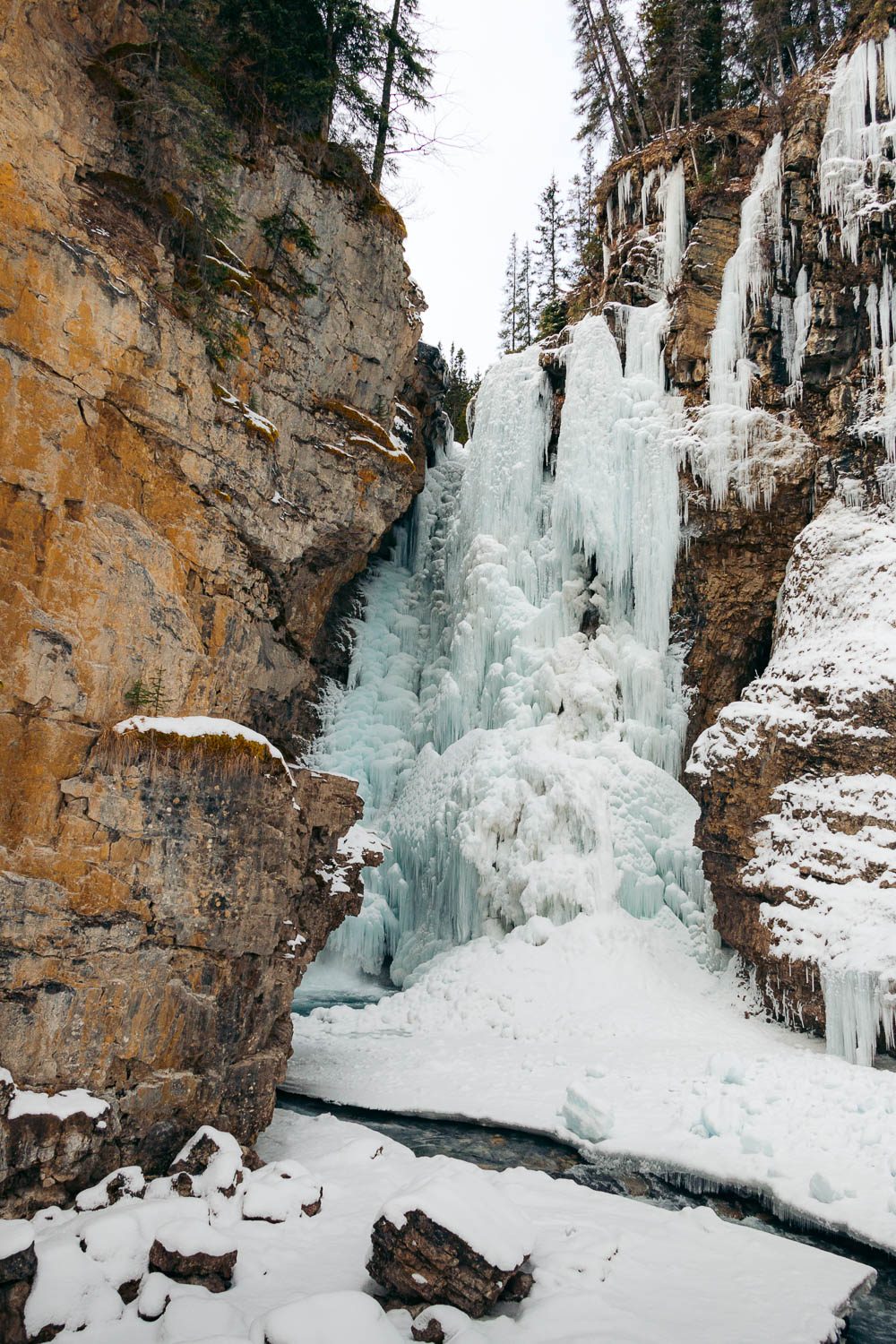
Johnston Creek did not always run through this gorge. The stream was diverted here after the last glaciation and has since cut more than thirty metres down through soft Palliser limestone, carving a slot so narrow that engineers gave up on a ground-level path and bolted a steel catwalk directly into the canyon wall. In summer that catwalk is simply a walkway. In winter it becomes the reason the johnston canyon winter trail requires a different mindset from every other Bow Valley Parkway hike. The transformation begins when spray from the Lower Falls freezes onto the railings and decking. Meltwater seeps through the rock face, refreezes overnight and glazes the walkway in clear ice that is difficult to see against wet metal. Sections closest to the water hold that glaze longest, sometimes into April, well after the parking area has cleared. Above the Upper Falls, the frozen curtain that draws ice climbers builds through January and February, and the amphitheatre below it collects cold air that keeps temperatures several degrees under the readings at the trailhead. Visitors who judge the day from their car window routinely underestimate what the canyon floor is doing. Surface conditions vary more than distance does. The walk to the Lower Falls is a little over a kilometre; the Upper Falls sit roughly a kilometre beyond. Neither is long. What changes is footing, and footing depends on the previous seventy-two hours of freeze-thaw. Chinook winds push temperatures above zero, the ice softens, and then a clear night refreezes everything into something closer to a rink. Parks Canada posts trail reports for exactly this reason, and checking them the morning of a visit is more useful than reading any static description of the route. Most people arrive at midday, which is when the canyon narrows feel congested and the ice is at its most polished from traffic. Those planning a Banff ice walk in winter generally do better treating the johnston canyon winter trail as an early-morning objective, moving through the lower catwalks before the crowd compresses the snowpack. Guided groups run through the season and supply traction gear, which is one way to remove the equipment question entirely. Independent visitors should plan around the conditions rather than the calendar — the canyon rewards patience and punishes assumptions about what a two-kilometre walk involves.
“Visitors who judge the day from their car window routinely underestimate what the canyon floor is doing.”
The most effective time to experience the Johnston Canyon winter trail is during the early morning hours. Arriving during the best arrival window of 00:00–08:00 helps avoid severe parking congestion and peak midday crowds.
Cold, often -10°C to -20°C
Ice formations are at their peak and most stable during these months.
Variable, -5°C to 5°C
Trails can become slushy; use traction aids as ice begins to melt.
—
Mid-week visits provide the quietest experience on the catwalks and trails.
—
Parking reaches capacity rapidly; avoid these times to ensure trail accessibility.
Verdict: The best time to visit is on a weekday morning between December and February, arriving within the 00:00–08:00 window.
Winter turns the Johnston Canyon trail into packed snow and glare ice, so the preparation that matters most is traction, layers, and light.
This sequence walks you from the Johnston Canyon trailhead through the catwalks to the Lower Falls and on to the Upper Falls, a round trip of roughly 5.2 km that most winter walkers complete in two to three hours. The route is a single maintained path with no navigation decisions, so the work is in reading the ice underfoot rather than finding the way.
Attach ice cleats in the parking area before you step onto the path, not once you feel yourself slipping. The first 200 metres of packed snow near the trailhead is where most falls happen, because it looks flat and people delay putting cleats on.
From the trailhead the trail climbs gently alongside Johnston Creek on a wide gravel-and-snow surface. Stay on the marked path rather than dropping to the creek bed, since snow bridges over open water can look solid and give way.
About 1 km in, the trail transfers onto steel catwalks bolted to the canyon wall. The grated decking ices over invisibly under a dusting of snow, so keep one hand on the railing and step flat-footed rather than pushing off your toes.
A short signed side path and footbridge lead to the Lower Falls viewing tunnel at roughly 1.2 km. The tunnel floor is a polished ice sheet and the low rock lip at its mouth catches heads and feet, so slow down before entering.
Return to the main trail and carry on 1.4 km to the Upper Falls, where the grade steepens through switchbacks. This upper stretch stays shaded and holds harder ice than the lower canyon, so expect the surface to change even if the first half felt easy.
A lower platform sits at the base of the frozen column and a short climb reaches the upper platform above it. Keep well back from the ice wall and any climbers below it, as falling ice released by climbers and by afternoon sun lands in the base area.
Return by the trail you came up rather than looking for a loop, since there is no alternative winter descent. Descending is when traction fails most often, so shorten your stride on the catwalk sections and keep cleats on until you are back at the parking lot.
The Johnston Canyon winter trail remains accessible 24 hours a day, seven days a week. Visitors should exercise caution regarding trail conditions, as icy paths and limited visibility during non-daylight hours require appropriate equipment and preparation.
These operational hours remain consistent throughout the year; however, winter conditions significantly affect trail access and safety requirements.
Johnston Canyon is located along the Bow Valley Pkwy, Improvement District No. 9, AB, Canada. Access is primarily achieved via personal vehicle or private shuttle services from Banff.
Trans-Canada Hwy (Hwy 1) to Bow Valley Pkwy
Roam Transit Route 9 from Banff
Direct transfer from Banff townsite
Winter road conditions on the Bow Valley Parkway can be unpredictable, requiring winter tires or chains. Arrive between 00:00–08:00 to secure parking, as the lot reaches capacity quickly during peak hours.
Everything you need to know about johnston canyon winter trail
The trail can be slippery due to ice accumulation, making traction aids like crampons or ice cleats essential for safety. Hikers should remain on the designated path to avoid the steep canyon drop-offs and potential hazards near the water.
Yes, visitors must have a valid Parks Canada pass to enter Banff National Park, which covers the area where this trail is located. The daily entrance fee is 12.25 CAD per adult to access these park facilities.
A round-trip hike to the Upper Falls typically takes between 2 to 3 hours depending on your pace and icy conditions. Plan for extra time to capture photos of the limestone cliffs and frozen cascades along the way.
While not strictly mandatory, wearing micro-spikes or crampons is highly recommended to navigate the icy catwalks safely. Without proper footwear, the incline and frozen surfaces pose a significant slip hazard to hikers.
Families can enjoy the walk, but caution is necessary because the path often features narrow sections and icy patches. Keeping children close and using appropriate footwear ensures a safer experience while viewing the spectacular rock formations and frozen falls.
Arriving between 00:00–08:00 is recommended to avoid heavy traffic and crowded parking areas. Visiting during this early window provides a much quieter experience before the peak midday volume arrives.